Saturday, July 1, 2017

Who was Joseph Warren?


With Fourth of July coming up, let's take a look at a founder who backed his beliefs in word and deed. Joseph Warren began practicing medicine in Boston at the age of 22--after graduating from Harvard at 14--making him the youngest doctor in Boston. Although the relationship between the colonies, particularly Massachusetts, and Great Britain had been deteriorating for years, it was the public reaction to Great Britain's passage of the Stamp Act   that caused Dr. Warren to join the ranks of the Patriots. 

Great Britain's oppressive treatment of Massachusetts led Samuel Adams to propose committees of correspondence to facilitate communications among the counties and towns of Massachusetts. And Joseph Warren was an early supporter of this idea, which eventually would be used to tie the 13 Colonies together. In November 1772, the Boston Committee of Correspondence produced the Boston Pamphlet. This document comprised three sections: (1) "A State of the Rights of the Colonists and of this Province in particular"; (2) "A List of the Infringements and Violations of those Rights"; and (3) "A Letter of Correspondence with the Other Towns." Samuel Adams was the primary author, and he wrote part one. Dr. Benjamin Church wrote part three. And Joseph Warren wrote part two. 

Dr. Warren listed 12 acts by Great Britain that violated the colonists' rights. These included passing laws without the colonies' consent, imposing taxes on the colonists without their consent, authorizing the military to use the general warrant to enter any house, shop, ship, etc. where the officials suspected that they could find goods for which the taxes had not been paid, and depriving the colonists of the right to trial by jury. Another act opposed by the Boston Committee of Correspondence was Great Britain's using revenue from these illegal taxes to pay colonial officials. The Committee knew that Great Britain's paying these officials would make them more interested in doing King George's bidding than protecting the colonists' rights. This, however, was not the end of Dr. Warren's lists. 

In May 1774, Parliament passed the Massachusetts Government Act as part of the Intolerable Acts--known in Great Britain as the Coercive Acts. The Intolerable Acts were in response to the Sons of Liberty's tea party in Boston Harbor in late 1773. The Massachusetts Government Act effectively voided Massachusetts's Charter, and it reduced Massachusetts to a Crown Colony. In September 1774, almost two years after the Committee's 1772 Boston Pamphlet, Dr. Warren wrote the final version of the Suffolk Resolves. The Suffolk Resolves were the Boston Committee of Correspondence's response to the Intolerable Acts. The Suffolk Resolves set forth 19 objections to Great Britain's treatment of the colonies. 


After the Committee approved the Suffolk Resolves, Dr. Warren dispatched Paul Revere to carry the Resolves to the First Continental Congress then meeting in Philadelphia; he completed the 350-mile journey in five days. The Continental Congress adopted the Suffolk Resolves word for word.

One could rightfully expect that Dr. Warren, having proven himself as a drafter of grievances, might be involved more directly with the Declaration of Independence. But you will search in vain among the names of the 56 signers of the Declaration for Dr. Joseph Warren. Why?

In April 1775, the British were preparing to attack Boston. William Dawes and Paul Revere were given the job of spreading the word when the British made their move. And just as Dr. Warren had done in September 1774 when he sent Revere to Philadelphia with the Suffolk Resolves, he dispatched Dawes and Revere on their rides to warn that the British were coming. And two months later, on June 17, 1775, the Battle of Bunker Hill was fought. The battle was fought mostly on Breeds Hill.

Only a few days before the battle, the Massachusetts Provincial Congress had appointed Dr. Warren as a major general. Dr. Warren, however, was true to his convictions; having protested Great Britain's oppression in speeches and writings, he did not wish to be in command at a safe distance from the battle. So six days after his 34th birthday, Dr. Warren gave up his commission and fought alongside the other volunteer soldiers. Dr. Warren was killed in the battle. And this is why you won't find his name among the signers of the Declaration of Independence. But his spirit surely is.    


Monday, June 19, 2017

Trademark and the First Amendment

Today, the Supreme Court of the United States (Gorsuch, J., not participating) held in Matal v. Tam that the Patent and Trademark Office's denial of a trademark to the band The Slants violated the First Amendment. The band wanted to trademark its name. The PTO denied the application because it determined that the registration of this name as a trademark would "'disparage . . . or bring . . . into contemp[t] or disrepute' . . . 'persons, living or dead.'" Matal v. Tam, No. 15-1293 at 1 (quoting 15 U.S.C. §1052(a)).

Justice Alito delivered the Court's opinion as to Parts I, II, and III-A. Seven other justices joined as to these parts with the exception of Justice Thomas's not joining Part II. Alito also wrote the opinion as to Parts III-B, III-C, and IV in which he was joined by Roberts, C.J., and Thomas and Breyer, JJ. Justice Kennedy wrote an opinion concurring in part and concurring in the judgment; Ginsburg, Sotomayor, and Kagan, JJ., joined. Finally, Justice Thomas wrote an opinion concurring in part and concurring in the judgment.

Part I is simply an overview of trademark law and background on the case. Part II addressed whether the statute applies to racial or ethnic groups as opposed to applying only to natural or juristic persons. Because Tam did not raise this issue in the lower court, SCOTUS did not grant certiorari on this issue. The government, however, urged the court to review this issue because it might avoid the constitutional question. Courts prefer avoiding decisions on constitutional grounds when they can. The Court, however, rejected Tam's argument as not supported by the text of the statute. Justice Thomas disagreed with Part II only because he felt the denial of certiorari on this issue should have ended the inquiry. Justice Thomas also argued that strict scrutiny applies when the government tries to suppress truthful speech even if it is characterized as commercial speech. The Court applied a less stringent test; because the Court even under the less stringent test found the statute unconstitutional, Thomas concurred in the judgment.

In Part III-A, the Court in an 8-0 opinion rejected the government's claim that the issuing of a trademark is government speech and therefore outside of the First Amendment. In rejecting the government's argument, the Court said that if registering trademarks is government speech, the government is "babbling prodigiously and incoherently."

In Par III-B Alito and three others rejected the government's claim that registering a trademark was analogous to a government subsidy and outside of the protection of the First Amendment. Likewise, in Part III-C Alito and three others rejected the applicability of the government's proposed "new doctrine that would apply to 'government-program' cases."

In Part IV, Alito discussed which standard should apply, but ultimately did not decide the issue because the statute in question failed under either standard. (Thomas would have reached this issue and applied strict scrutiny.)

In Kennedy's opinion (joined by three others) he concluded that the statute is unconstitutional because it is viewpoint discrimination. And he believed that this conclusion was all that was necessary to decide the case. Kennedy noted that the government's argument, i.e., the statute is viewpoint neutral because it prohibits all sides from disparaging others, was illogical. "By mandating positivity, the law . . . might silence dissent and distort the marketplace of ideas."

The bottom line is that the Court's judgment is 8-0 that the statute violates the First Amendment, and this is the right conclusion.


Tuesday, June 6, 2017

73rd Anniversary of D-Day

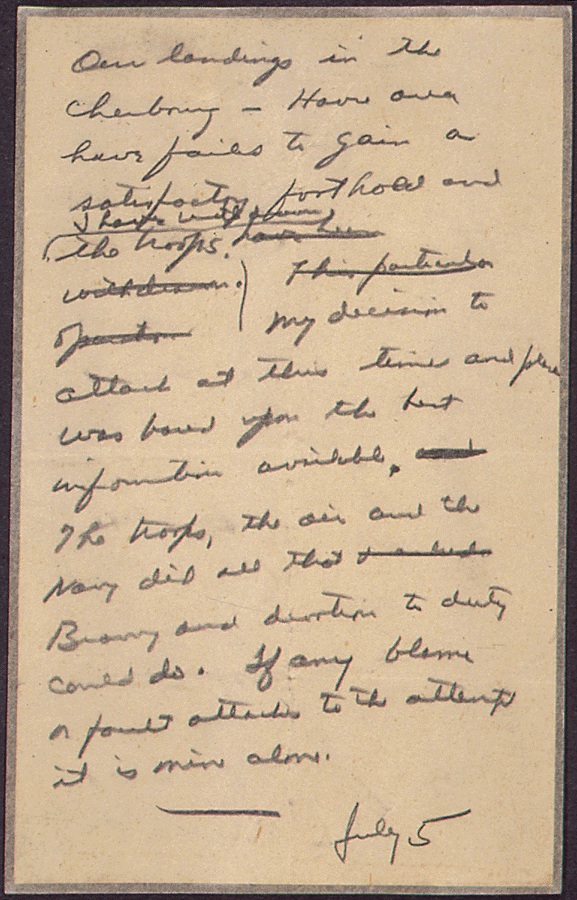
Today marks the 73rd anniversary of D-Day. On this day—73 years ago—“4,000 ships, 11,000 planes, and nearly three million soldiers, marines, airmen, and sailors assembled in England for the assault.”  The invasion succeeded, but success was not a foregone conclusion. Failure was as likely an outcome. Eisenhower wrote a note on June 5, 1944, accepting responsibility for the failure. (He mistakenly dated it July 5.)   It is doubtful in our era that we have leaders who would willingly accept such blame.

The first quote mentions the marines; students of history will question this as there are no stories of heroism by the U.S. Marines on D-Day. And if the Marines were involved, such stories would abound. By 1944, the Marines were masters of the amphibious assault. The Marines trained the Army in how to conduct amphibious landings in North Africa, Italy, and, yes, Normandy. But the Marines did not play a large role in the European Theatre. The Marines had their hands full in the Pacific, and they were much smaller than the Army; the Marines had six divisions in WWII compared to the 89 divisions of the Army. Some, however, attribute the Marines not playing a large role in Europe to the Army’s jealousy from WWI where the Marines received a lot of press for the success of the Battle of Belleau Wood. Marshall, Eisenhower, and Bradley were WWI veterans. I don’t know if there are any facts to back this up. I’ve always thought the Marines played a larger role in the Pacific Theatre because they are part of the Dept. of the Navy and the Navy, by virtue of the nature of the Pacific Theatre, played such a large role in the Pacific.


But today we ignore the pettiness that rules man, and remember those who did the unthinkable and broke the Nazi stranglehold on Europe.   

Wednesday, March 15, 2017

"For want of a comma"

The following sentence is from an exemption to Maine’s overtime law:  “The canning, processing, preserving, freezing, drying, marketing, storing, packing for shipment or distribution of (1) agricultural produce; (2) meat and fish products; and (3) perishable foods.” Under the exception, employees engaged in these specified job processes are not entitled to overtime.

In O'Connor v. Oakhurst Dairy, --- F.3d ---, 2017 WL 957195 (1st Cir. 2017), a dairy’s delivery drivers sued claiming that they were entitled to overtime because they don’t “pack for distribution”; therefore, they are not exempt from the overtime law. The drivers’ argued that the lack of a comma between “shipment” and “or” results in the exemption applying only to those involved in “packing for distribution.”

The district court said “oh pooh, everyone knows that Maine’s legislature intended “packing” to modify “for shipment” and not “distribution.” The First Circuit said “not so fast lowly district judge.” The court goes through a lengthy discussion about the various grammar arguments in favor of each interpretation, e.g., parallelism and asyndeton.

You should use the serial or Oxford comma before the conjunction that joins the last two items in a series of three or more. The Chicago Manual of Style § 6.18 (16th ed. 2010). The Maine legislature violated this rule, and this led to this overtime case going to the First Circuit. In their defense, however, the drafters followed the Maine Legislative Drafting Manual that specifically directs drafters to omit the comma “between the penultimate and the last item of a series.” The manual goes on to provide that the comma should be used if needed to prevent ambiguity. The strongest points in favor of the dairy are the manual and the absence of a conjunction before “packing.” If “packing for shipment or distribution” were intended to be the last element in the series—as the drivers argue—one would expect a conjunction before “packing.”   

The First Circuit noted that each item in the list is a gerund, and parallelism requires that “every element of a parallel series must be a functional match of the others . . . and serve the same grammatical function . . . .” O’Connor v. Oakhurst Dairy, --- F.3d ---, 2017 WL 957195 at *5 (1st Cir. 2017) (citing The Chicago Manual of Style § 5.212 (16th ed. 2010)). Each gerund refers to a stand-alone activity; therefore, “packing”—the last gerund in the list—applies to both “shipment” and “distribution.” And the lack of the serial or Oxford comma, when coupled with the court’s other grammar observations, led the court to conclude that “for want of a comma” the drivers were entitled to overtime.


Some of you were trained not to use the serial comma, but I urge you to follow The Chicago Manual of Style: “Chicago strongly recommends this widely practiced usage . . . since it prevents ambiguity.” The Chicago Manual of Style § 6.18 (16th ed. 2010). By quoting Chicago’s use of “since” I made the skin of some of you crawl; you prefer or insist that “since” be used only in the temporal sense; you prefer that “because” be used here. You are free to reject “since” in a causation sense, but such use pre-dates Chaucer. Superstitions, Bryan A. Garner, Garner’s Modern English Usage (4th ed. 2016), at p. 877. So I wouldn't be too hard on those who use "since" in both senses. 

Thursday, September 22, 2016

UT Law School dean supports free speech except speech that . . .

If you follow @instapundit on Twitter, you are familiar with Twitter's decision to suspend Professor Glenn Reynolds. The reason for doing so was that Twitter didn't like his message! During the Charlotte riots thugs surrounded cars on the Interstate. Professor Reynolds tweeted "run them over." This advice was as opposed to sitting in your car until the thugs pulled motorists from their cars and beat them. 

Well, the sanctimonious Left rose up in outrage--this led to Twitter's action--and demanded action be taken. Twitter did reverse itself; but now UT Law dean Melanie Wilson has decided to investigate Professor Reynolds's speech. (Professor Reynolds teaches law at UT.) Dean Wilson assures us that she supports free speech except speech "that encourages violence." And apparently it is she who will make that determination. 

The surrounded motorists who are on Twitter and who follow @instapundit on Twitter probably had more pressing matters last night than checking Twitter. And by the time they were removed from the situation and checked Twitter it would have been too late for them to run the rioters over. So much for the dean's opposition to speech "that encourages violence." There was no real opportunity for the readers to engage in violence. And if my family and I had been surrounded by that band of thugs, I wouldn't have needed the good professor's advice: it sounds more like self-defense!

Don't let Dean Wilson and her ilk dictate to us the speech that should be allowed and the speech that should not be allowed. 

Here is the text of my e-mail to Dean Wilson and her e-mail address is mdwilson@utk.edu you can also try utk.edu@cmail20.com

Dear Dean Wilson,
Your claim to support free speech is belied by the statement that you don't support speech  "that encourages violence." And it is you who determines that? The speech you support is speech with which you agree. Otherwise, you would simply have told those whom Professor Reynolds offended that you are not in the business of policing speech. 

But I'll play your game and assume you should take action against speech "that encourages violence." How would Professor Reynolds's tweet have encouraged violence last night? Those in their cars who were surrounded by a mob on the Interstate would have had more pressing matters to deal with than checking Twitter. And by the time they were removed from the situation and looked at Twitter, assuming they follow Professor Reynolds, it would have been too late. 

If you insist on policing speech, please don't do it under the banner "I support free speech." Be honest and acknowledge that you support speech with which you agree and investigate all other speech.

Let the dean know how you feel!
  

Thursday, September 15, 2016

53 days till the election

With 53 days remaining before the election, I thought I would challenge a couple of the reasons given for voting for Trump.

Trump says that he will push for women to have six weeks paid maternity leave. And he says he will appoint folks to the Supreme Court who are like Scalia.

A. He's a Conservative. Not true!
Maybe you think the first point is a good idea; and maybe so if the employer decides to offer it as a perk to its employees. But it is contrary to conservative principles for the government to force private employers to do this. Why? Because it is contrary to liberty. Some folks say, "Let's see how Donald plans to pay for it." He will pay for it through higher taxes or putting a bigger burden on employers. It's no mere coincidence that Hillary proposes the same thing only larger.

B. He will appoint Scalia-like folks to SCOTUS. 
Now, Trump hasn't got enough sense to know anything about Scalia. One can't be a narcissist and an intellectual: there's not enough time in the day. Trump's sister is a federal judge and her mother is the only person she’s ever thought shouldn't have an abortion. (One can't say there's a constitutional right to own slaves (Scott v. Sandford), to abortion (Roe v. Wade), to engage in homosexual acts (Lawrence v. Texas), or to buy condoms (Eisenstadt v. Baird),  and claim to be textualist in the vein of Scalia.) These are matters for the legislative branch--in the first instance--and the executive branch. Trump will not appoint to the Supreme Court the kind of folks we need there.

C. One of these reasons for voting for Trump is better than the ones discussed above.
So, if you want to vote for Trump, go ahead. But don't do it because he's a Conservative, he's not! Do it because you don't like Hillary, do it because Trump looks better in pants than Hillary, do it because you want more government in your business but at a slower pace, do it because you admire fascism, do it because Trump is more consistent with his hairstyle than Hillary, do it because Sean Hannity told you to, but don't do it because Trump is a Conservative.


And not voting for Trump is not a vote for Hillary. Our presidents are elected by the members of the electoral college. Hillary is not going to win Tennessee. Tennessee’s electors will go to Trump. Throw caution to the wind and write in a candidate or if marijuana is your thing, Gary “what’s Aleppo” Johnson will gladly take your vote.  

Thursday, August 11, 2016

This week lawyers are having trouble with precedent.

Sandy Springs, GA bans sex devices unless needed for a bona fide medical, educational, scientific, legislative, judicial, or law enforcement purpose. The plaintiff sued claiming she needs a vibrator because her M.S. prevents her from getting sufficient pleasure from her partner. The Eleventh Circuit upheld the ordinance. But that’s not the important point; unless you live in Sandy Springs.

A lawyer writing an article about the case, wrote that the Eleventh Circuit “was more or less bound by previous precedent . . . .” Is there another kind? Black’s Law Dictionary defines precedent as “a decided case that furnishes a basis for determining later cases . . . .” Hence precedent—by definition—must be before, i.e., previous to, the case to which it applies.


Precedent is giving lawyers trouble this week. Earlier this week a lawyer wrote in an e-mail “there's some good precedence” in the appellate court. Precedence is “the order or priority in place or time observed by or for persons of different statuses on the basis of rank . . .” or “the act or state of going before something else according to some system of priorities.” And precedent we’ve already covered. Because the lawyer meant “precedents” she should have written “there are some good precedents . . . .” 

Things to remember: "precedent" and "precedent" are homographs, i.e., words that are spelled the same, pronounced the same, but have different meanings and they are also a more specific type of homograph the heteronym: heteronyms are words that are spelled the same, have different meanings, and sound different. "Precedent" is pronounced prə-seed-ənt and pres-ə-dənt and means preceding in time or order. "Precedent" is pronounced pres-ə-dənt and is a decided case that furnishes a basis for deciding a later case. Finally, there is "precedence" that is pronounced either pres-ə-dənts or prə-seed-ənts and I defined it above. Oh, and if you are going to Sandy Springs, check your bags because there are some things you can't by their; just kidding "buy there."